
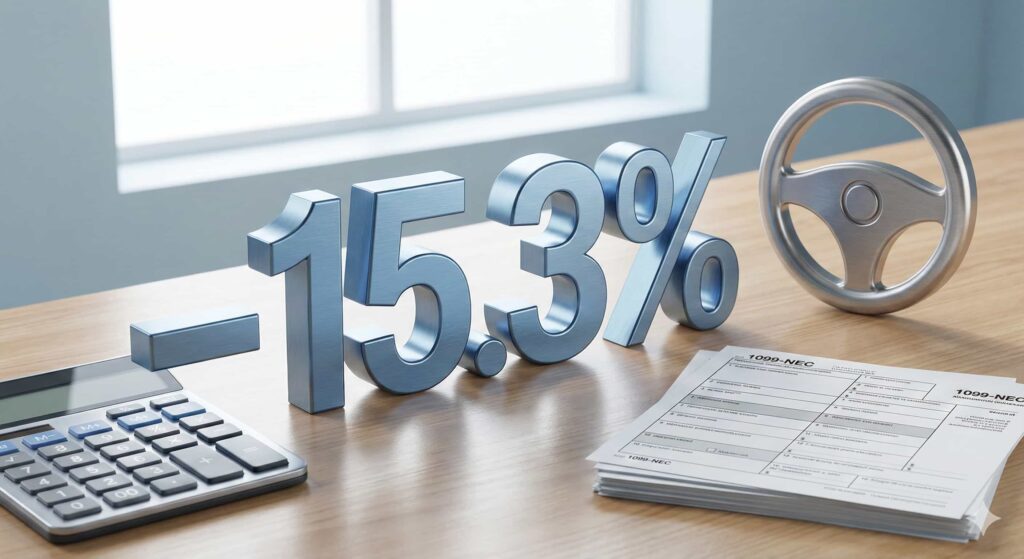
When you drive for Uber, Lyft, or DoorDash, you often hear the dreaded number: 15.3%. Specifically, this is the Self-Employment (SE) tax that every independent contractor in 2026 must face. For many drivers, misunderstanding this tax is the single biggest reason they overpay the IRS.
While a W-2 employee only sees about half of this taken from their paycheck, you are responsible for the entire amount. However, once you understand how it works, you can use smart strategies to keep more of your earnings.
The Breakdown: Why is it 15.3%?
This tax replaces the payroll taxes that W-2 employees split with their employer. When you work as a W-2 employee, your boss pays half of your Social Security and Medicare taxes. When you drive for Uber or Lyft, you are the boss, which means you pay both shares.
- Social Security: 12.4%
- Medicare: 2.9%
- Total: 15.3%
The Strategy: Lower Your Net Profit The 15.3% tax is only applied to your net profit (Income minus Expenses). This is why tracking every mile is crucial. By maximizing your mileage deduction, you directly reduce the amount of money subject to this tax.
You can Calculate Your Tax Savings Now → using our dedicated self-employment tax estimator and see the difference in real dollars.
Why Do You Have to Pay Both Halves?
In the eyes of the IRS, your driving business is a two-person operation: you are the employer and the employee. Consequently, you must pay the employer’s 7.65% share and the employee’s 7.65% share. Combined, this equals the 15.3% self-employment tax.
In fact, this tax goes directly toward your future benefits. The 12.4% funds your Social Security, and the 2.9% funds your Medicare coverage. Moreover, the IRS provides a small break: you can deduct the “employer-equivalent” portion of your SE tax when calculating your adjusted gross income (AGI).
The IRS Calculation Hack: The 92.35% Rule
This is why many drivers ask: “Why isn’t self-employment tax applied to 100% of my income?”
Fortunately, the IRS doesn’t tax 100% of your net earnings. Instead, they apply the 15.3% tax to 92.35% of your net profit. Specifically, this calculation (found in IRS Publication 334) is meant to mimic how W-2 employees are taxed only on their take-home pay.
Simple Math Example: If your net profit after mileage and expenses is $40,000:
- IRS calculates 92.35% of that: $36,940
- Then applies the 15.3% tax: $5,651.82
As a result, tracking your expenses lowers the $40,000 base, which in turn lowers the final tax bill significantly.
How to Battle the 15.3% Tax in 2026
Ultimately, your goal isn’t just to increase your revenue, but to decrease your taxable profit. Therefore, you should never leave money on the table.
- Log Every Business Mile: Whether you use the Standard Mileage Rate or Actual Expenses, your car is your biggest tax shield. Use the 2026 IRS Mileage Deduction Calculator to stay precise.
- Track “Between-Ride” Miles: Many drivers forget that the miles driven between drop-offs and new pickups are also deductible.
- Keep Mobile Records: Use a dedicated app or a simple logbook to ensure you can prove your deductions if the IRS ever asks.
🛡️ Important Disclaimer & Fact-Check
This guide is based on 2026 IRS tax projections and IRS Publication 334 (Tax Guide for Small Business). Because individual tax situations vary, this is for simulation and educational purposes only and is not official legal advice. Tax laws and thresholds may change, and this content is updated annually for accuracy. Finally, we strongly recommend consulting a CPA to ensure your Net Profit is calculated accurately. Data Source: IRS.gov.
✅ Take Control of Your 15.3% Tax:
1 thought on “What is the 15.3% Self-Employment Tax? (A Guide for Drivers)”