
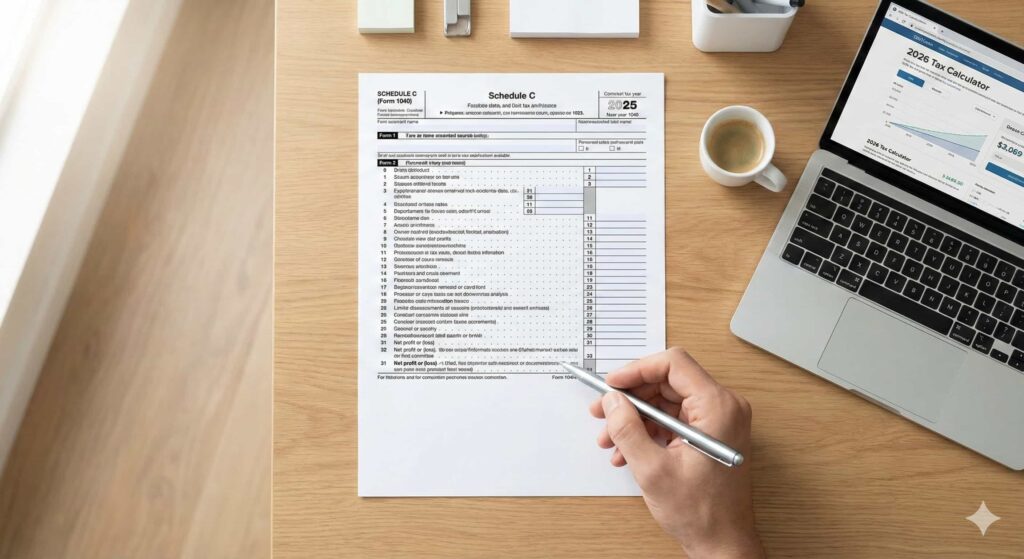
For independent contractors, IRS Schedule C (Form 1040) is arguably the most significant document in a tax return. This form is where you determine the net profit or loss of your business for the year. By accurately reporting your income and allowable expenses, you establish the foundation for your final tax liability. Understanding this flow allows you to use the 2026 Federal Tax Estimator to its full potential.
What is Schedule C (Form 1040)?
Schedule C is titled “Profit or Loss From Business (Sole Proprietorship).” Generally, anyone who receives a 1099-NEC or operates as a freelancer must file this form alongside their standard Form 1040. The “Net Profit” calculated on this form becomes the basis for your self-employment tax obligations.
Step 1: Reporting Gross Income (Part I)
In this section, you list all the revenue that entered your business before deducting any costs.
- Line 1 (Gross Receipts): This includes the total amounts from your 1099-NEC and 1099-K forms, as well as any cash or check payments not reported on a formal tax document.
- Line 7 (Gross Income): This is your starting point after accounting for any returns or costs of goods sold (if applicable).
- Reference: IRS Publication 334 (Tax Guide for Small Business).
Step 2: Identifying Potential Business Expenses (Part II)
Part II is where you list the “ordinary and necessary” costs of running your business. These figures reduce your gross income to determine your actual taxable profit.
- Line 9 (Car and Truck Expenses): Used for reporting mileage or actual vehicle costs.
- Line 11 (Contract Labor): Fees paid to other independent contractors or freelancers.
- Line 24b (Deductible Meals): Under current IRS rules, business meals are typically 50% deductible, provided they have a clear business purpose.
- Line 30 (Home Office): Used for the “Business Use of Your Home” (Form 8829 or the simplified method).
- Reference: IRS Publication 535 (Business Expenses).
📊 Schedule C Quick Reference (2026)
| Form Section | What it Tracks | Impact on Tax Liability |
| Part I (Income) | Total gross 1099 revenue | Establishes the gross starting point. |
| Part II (Expenses) | Rent, ads, mileage, tech, etc. | Reduces the income subject to taxation. |
| Line 31 (Net Profit) | Final taxable business income | The number used to calculate SE tax. |
Step 3: Calculating Your Net Profit (Line 31)
Finally, you subtract your total expenses (Part II) from your gross income (Part I). The result on Line 31 is your Net Profit.
- If the number is positive: You have a business profit. This amount typically flows to Schedule SE to calculate your self-employment tax.
- If the number is negative: You have a business loss, which may, in certain circumstances, be used to offset other taxable income (subject to “at-risk” rules).
Maintaining Professional Records
The IRS expects precise reporting. To ensure your Schedule C remains compliant, follow these professional habits:
- Avoid Rounding: Use exact figures from your bank statements and receipts. Consistent rounding to the nearest $100 can be a signal for a secondary review.
- Retain Digital Backups: While you don’t submit receipts with your return, you must have them available if requested. Use digital scanning tools to maintain organized, accessible records.
📊 2026 Tax Planning Resources:
- 📊 2026 Federal Tax Estimator
- 💰 Self-Employment Tax 101: The 15.3% Rule
- 📝 Mastering 1099 Expense Tracking Guide
🛡️ Important Disclaimer
This guide and the associated Federal Tax Estimator are for informational purposes only and do not constitute professional tax, legal, or financial advice. This information cannot be definitively confirmed as applicable to every individual case; please check with an IRS official document or a tax professional. Calculations are based on projected 2026 tax frameworks. Data Source: IRS Publication 334 and Form 1040 Schedule C Instructions.
✅ Prepare for Tax Season Now: