

For the independent contractor, freelancer, and gig worker, the “Audit” is the ultimate tax-season nightmare. However, as we enter the 2026 tax year, the landscape has shifted. The IRS has significantly increased its budget for enforcement, specifically targeting Schedule C filings through advanced AI-driven data matching.
Understanding these 2026 IRS Audit Red Flags is no longer optional—it is a vital part of your business survival strategy. Misunderstanding these triggers is the fastest way to attract unwanted IRS attention. In this guide, we explore the exact triggers that cause the IRS’s computers to flag a return and how you can build an audit-proof defense.
1. The Reporting Mismatch: 1099-K and 1099-NEC Discrepancies
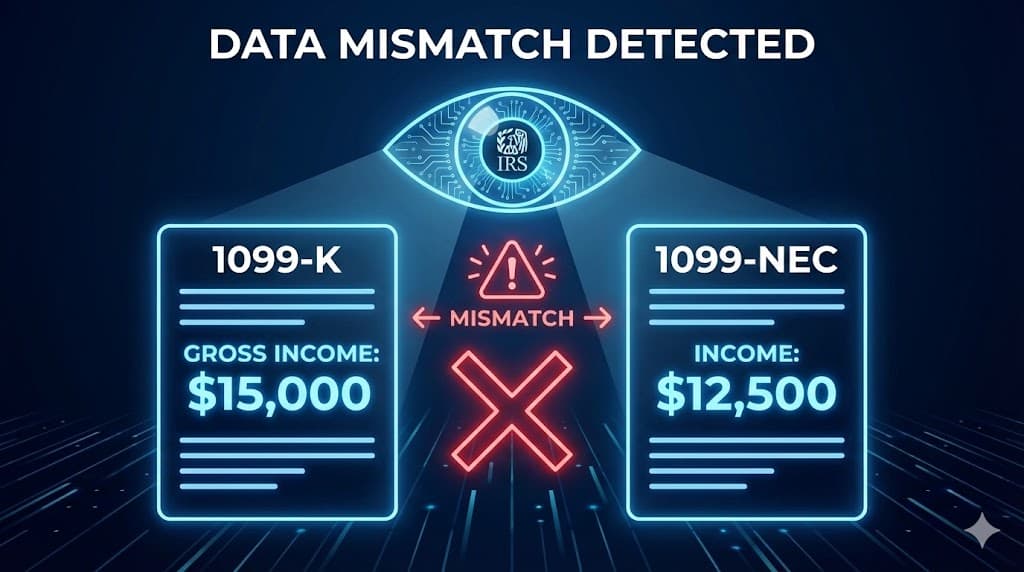
One of the most common reasons for an automated IRS notice in 2026 is a simple math mismatch. The IRS receives copies of every Form 1099-NEC and 1099-K issued to you.
The Red Flag: If your tax return shows $45,000 in gross receipts, but the IRS’s database shows 1099 forms totaling $50,000, an automated notice will be triggered.
The 2026 Context: Under the One Big Beautiful Bill Act (OBBBA) signed in July 2025, the 1099-K reporting threshold has officially reverted to $20,000 and 200 transactions. While this reduces the number of forms sent out, you are still legally required to report every dollar of income, regardless of whether you received a form.
2. The “Round Number” Psychology
When you see a tax return that lists “Office Supplies: $500.00” and “Travel: $1,500.00,” it signals one thing to the IRS: Guesswork.
The Red Flag: Using zeros in the tens and hundreds place across multiple expense categories. Real-world business expenses are messy. If your numbers are too “clean,” the IRS assumes you haven’t kept your receipts.
How to Avoid: Always report the exact cent (e.g., $1,243.56). Using exact figures from your bank statements provides a layer of credibility that rounded numbers lack. Photographic documentation of your receipts can further substantiate these precise figures.
3. Claiming 100% Business Use of a Vehicle
This is perhaps the “oldest trick in the book” and the one the IRS watches most closely. It is almost impossible for a personal vehicle to be used 100% for business unless it is a specialized commercial van parked at a business lot.
The Red Flag: A Schedule C showing 15,000 business miles and 0 personal miles.
The Fix: Be realistic. Even if you drive 95% for business, the personal use must be reflected. The best defense is a contemporaneous mileage log.
- Pro Tool: Estimate your realistic split using our 2026 IRS Mileage Deduction Calculator.
4. Disproportionate Deductions (The DIF Score)
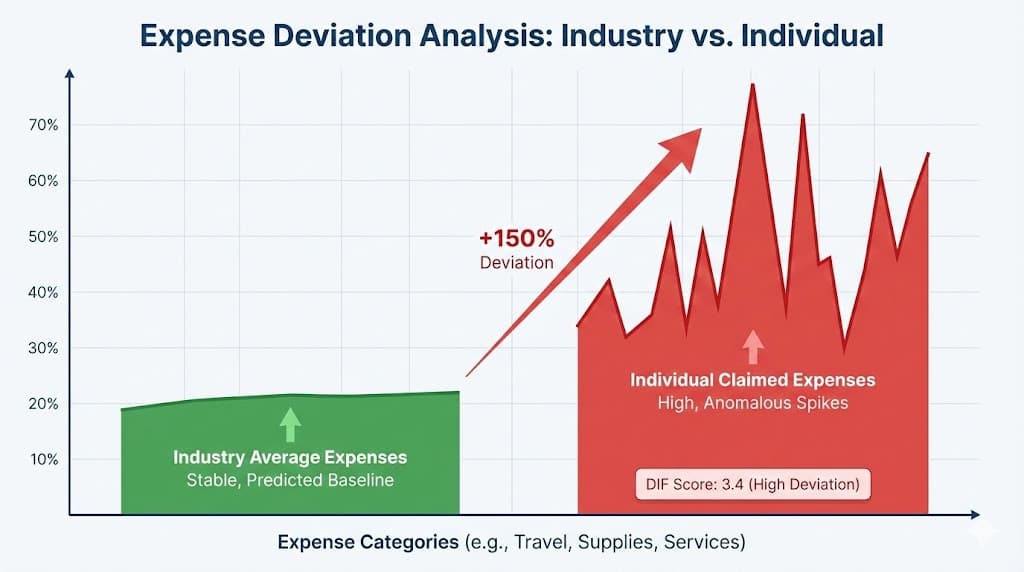
The IRS uses a “Discriminant Inventory Function” (DIF) Score to compare your deductions to industry averages.
The Red Flag: Claiming expenses that take up 80% or 90% of your gross income. Consequently, if your expenses are unusually high, attach a supplemental statement explaining why (e.g., “Major engine repair”).
5. The “Hobby vs. Business” Trap (Section 183)
The IRS will not let you deduct expenses for a hobby to offset other income.
The Rule: Your activity is generally considered a business if it has been profitable in 3 out of the last 5 years. The Red Flag: Reporting a net loss year after year while having a high-paying W-2 job. Therefore, you must document your “Profit Motive” by keeping a separate business bank account and a clear marketing plan.
6. Excessive Home Office Deductions
The Home Office deduction is a powerful tool, but it requires the space to be used regularly and exclusively for business.
The Red Flag: Claiming a large percentage of a small apartment as an office. If your office is also your guest bedroom, it is disqualified. How to Avoid: Measure your space accurately and follow our Home Office Rules guide to ensure you meet the criteria.
🛡️ Survival Guide: What to Do If You Receive an IRS Letter

Most audits in 2026 are “correspondence audits” (like Notice CP2000) done through the mail.
- Read the Deadline: You usually have 30 days to respond. Missing this is a critical mistake.
- Provide Proof: Gather exact receipts for the flagged item.
- Stay Organized: Provide evidence in a clean, chronological format.
🛡️ Important Disclaimer & Fact-Check
This guide is based on 2026 IRS tax rules, including IRS Notice 2026-10 (which set the 2026 mileage rate at $0.725) and the One Big Beautiful Bill Act (OBBBA). Because individual tax situations vary, this is for educational purposes only and is not official legal advice. This content is updated annually for accuracy. Finally, consult a CPA to review your specific risk factors. Data Source: IRS.gov.