
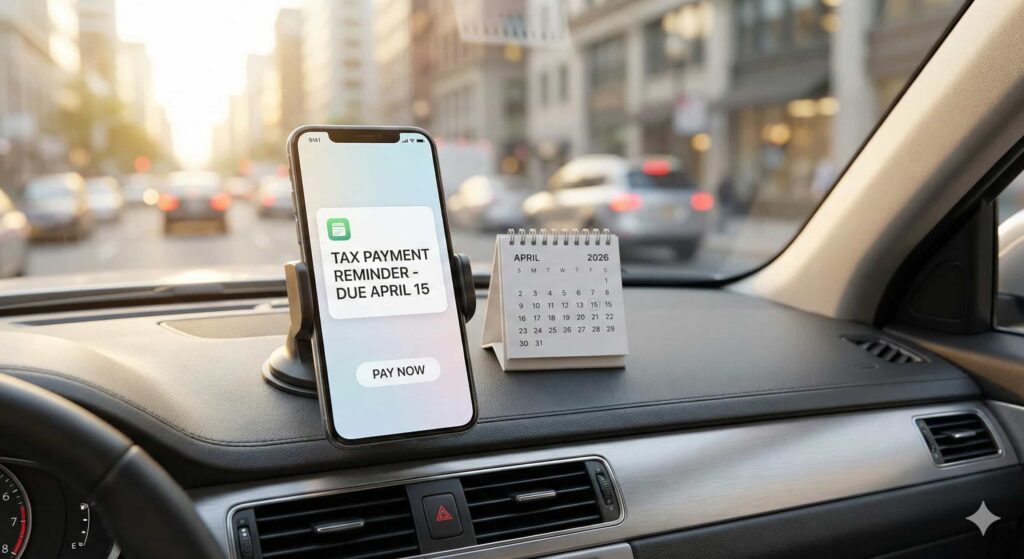
Driving for Uber or Lyft gives you incredible flexibility, but it also makes you a “tax entity” in the eyes of the IRS. Specifically, unlike a 9-to-5 job, nobody is withholding Social Security or Medicare from your rideshare earnings.
For this reason, mastering your quarterly taxes for Uber drivers is essential to avoid the dreaded “Underpayment Penalty.”
Why the IRS Expects You to Pay Every 3 Months
The U.S. tax system operates on a “pay-as-you-go” basis. Consequently, if you expect to owe more than $1,000 in total federal tax liability for 2026, the IRS generally requires you to send payments four times a year.
In fact, according to IRS Publication 505, waiting until the end of the year to pay everything at once can lead to interest charges and fines.
📅 2026 Quarterly Deadlines (Mark Your Calendar!)
Don’t let these dates slip by. As a result of missing a deadline, you could lose a chunk of your hard-earned driving profits to penalties. You can find more details on our 2026 Quarterly Estimated Tax Dates guide.
| Payment Period | Coverage Dates | 2026 Due Date |
| 1st Quarter | Jan 1 – Mar 31 | April 15, 2026 |
| 2nd Quarter | Apr 1 – May 31 | June 15, 2026 |
| 3rd Quarter | Jun 1 – Aug 31 | September 15, 2026 |
| 4th Quarter | Sep 1 – Dec 31 | January 15, 2027 |
Note: If a due date falls on a weekend or federal holiday, the deadline may shift to the next business day.
How to Calculate Your Payment (The Driver’s Strategy)
The biggest challenge for rideshare drivers is knowing exactly how much to send. Fortunately, you don’t have to guess if you follow a structured approach.
- Check Your App Summaries: Uber and Lyft provide monthly tax summaries. Moreover, these show your “online miles” and “gross earnings.”
- Deduct Your Miles First: Before calculating tax, you must subtract your mileage deduction from your gross pay. For 2026, using the projected IRS standard mileage rate is usually the most effective strategy for drivers. You can calculate this instantly with our 2026 IRS Mileage Deduction Calculator.
- Apply the 25-30% Rule: Most tax professionals generally recommend setting aside 25% to 30% of your Net Profit (Income minus Miles/Expenses). This covers both your 15.3% Self-Employment Tax and your marginal income tax.
[The Quarterly Payment Formula]
Quarterly Payment = Total Estimated Annual Tax ÷ 4
(To find your annual tax, use your estimated net profit after deductions for the entire year.)
Alternatively, you can use our 2026 Uber & DoorDash Tax Estimator to see exactly what you owe based on your real-time mileage and income.
How to Actually Send the Money
Furthermore, paying is easier than it sounds. You don’t need to mail a paper check. Instead, you can use IRS Direct Pay on the official IRS.gov website. It’s free, secure, and gives you an immediate receipt for your records. You can also pay through EFTPS if you prefer to schedule your payments in advance.
The Safe Harbor Rule: Your Insurance Policy
Finally, remember the “Safe Harbor” rule. If you pay at least 100% of the tax you owed in 2025 (110% if your Adjusted Gross Income was over $150,000), you generally won’t face penalties even if you underpay your 2026 taxes slightly. Therefore, looking at last year’s tax return is a great way to find your “safe” quarterly payment amount.
🛡️ Important Disclaimer & Fact-Check
This guide is based on projected 2026 IRS regulations and IRS Publication 505 (Tax Withholding and Estimated Tax). Because tax situations for rideshare drivers are unique and laws can change, this is not official legal advice. Calculations are based on projected 2026 IRS inflation adjustments and current tax law. Always consult a qualified CPA or tax professional regarding your specific tax situation. Data Source: IRS.gov.
✅ Keep Your Driving Business Tax-Ready: