
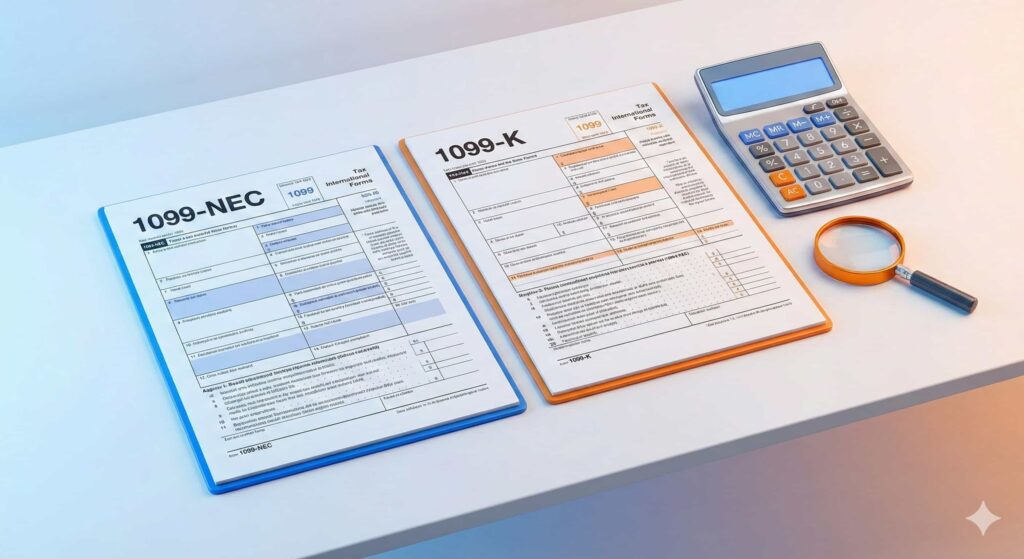
Every January, independent contractors often find themselves navigating a complex landscape of tax documents. In 2026, understanding the distinction between Form 1099-NEC and Form 1099-K is more important than ever for accurate filing. These forms report your income through different channels, and misinterpreting them could lead to errors on your tax return. By mastering these basics, you can use the 2026 Federal Tax Estimator more effectively.
1. What is Form 1099-NEC? (Non-Employee Compensation)
Businesses use Form 1099-NEC to report payments made directly to independent contractors for services rendered.
- Who issues it? Your direct business clients (e.g., a company that hired you for consulting or design work).
- The Threshold: Traditionally, businesses have issued this form for payments of $600 or more. However, taxpayers should verify current IRS reporting thresholds for the 2026 tax year, as these limits are subject to administrative adjustments.
- Practical Example: If a small business pays you for a freelance project via direct check or bank transfer, they will typically issue a 1099-NEC.
2. What is Form 1099-K? (Payment Card and Third Party Network Transactions)
Payment platforms such as PayPal, Stripe, or Venmo issue Form 1099-K. This form tracks the gross volume of digital transactions processed through these third-party settlement organizations (TPSOs).
- Who issues it? Payment settlement entities and third-party apps.
- Gross vs. Profit: Important: Form 1099-K reports gross transaction volume, not your taxable profit. Refunds, processing fees, and non-income transfers may be included in the gross amount and must be meticulously reconciled on Schedule C.
- IRS 2026 Framework: The IRS has updated the reporting thresholds for 1099-K forms in recent years to reflect changing digital economy standards. It is essential to check the 2026 1099-K Rules for Venmo & PayPal for the most current transaction limits.
📊 Key Differences at a Glance
| Feature | Form 1099-NEC | Form 1099-K |
| Primary Issuer | Direct Business Clients | Payment Platforms (e.g., PayPal, Stripe) |
| Reporting Focus | Specific services rendered | Total gross transaction volume |
| Common Use | Direct B2B payments | Digital/App-based payments |
| Tax Filing | Reported on Schedule C | Reported on Schedule C |
3. The “Double Counting” Trap: How to Avoid It
Duplicate reporting is a significant risk for 1099 earners. For example, if a client pays you via a platform like PayPal, you might receive a 1099-K from the platform and a 1099-NEC from the client for the same income.
How to manage this risk:
- Meticulous Record-Keeping: Do not simply add the totals of every form together without verification.
- Reconciliation: Ensure you only report your actual net earnings. Reporting the same income twice will lead to paying unnecessary tax.
- Best Practice: Start with your actual business income records (bank statements or bookkeeping software), then use 1099 forms only as cross-checking documents.
- Reference: IRS General Instructions for Certain Information Returns.
Why Accuracy Matters for Your 1099 Strategy
Confused about how these forms impact your final bill? Our 2026 Federal Tax Estimator simplifies the process. Instead of worrying about individual form codes, you can focus on your total net profit to simulate your potential tax liability instantly.
📊 2026 Tax Planning Resources:
- 📊 2026 Federal Tax Estimator
- 💰 Self-Employment Tax 101: The 15.3% Rule
- ⚖️ Standard vs. Itemized Deduction Guide
🛡️ Important Disclaimer
This guide and the associated Federal Tax Estimator are for informational purposes only and do not constitute professional tax, legal, or financial advice. Calculations are based on projected 2026 tax frameworks. Because individual tax situations are unique and IRS regulations are subject to change, always consult a qualified CPA or tax professional. Data Source: IRS.gov (1099-NEC and 1099-K instructions).
✅ Master Your 2026 Paperwork: